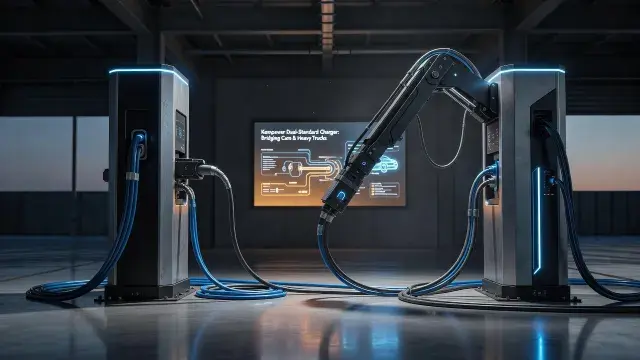
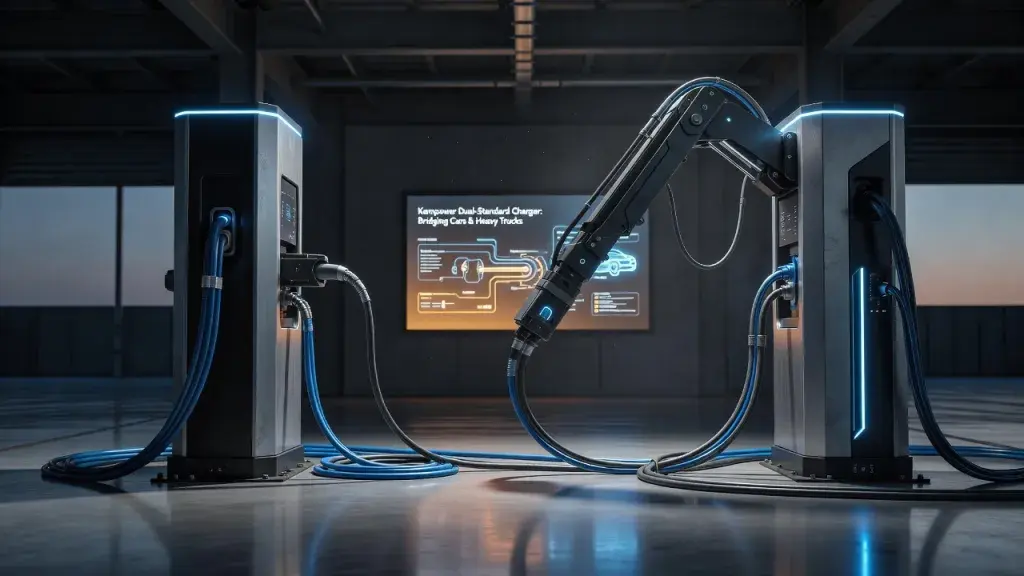
Kempower has introduced the Mega Satellite Flex, a charging dispenser built to serve both passenger electric vehicles and heavy-duty trucks from a single unit. The device supports the established CCS standard at up to 560 kW and the emerging Megawatt Charging System (MCS) at up to 1.2 MW, making it the Finnish manufacturer's first product to offer either standard on one machine. The announcement came this week at ACT Expo, where Kempower unveiled the charger during its Unplug & Recharge event for customers and partners.
Why One Dispenser for Two Standards Matters
The charging industry is in an awkward middle stretch. CCS remains the dominant connector for electric cars across North America and Europe, while MCS is only beginning to appear at freight corridors and depots built for electric trucks that demand far higher power to make sense economically. Building separate infrastructure for each vehicle class has meant duplicated trenching, transformers, and site work - costs that add up quickly for site operators comparing notes the way a driver might check connectivity through a UK server before committing to a route. Kempower's approach lets a single site serve cars and trucks without a second construction phase later, which shortens the timeline to profitability for charging point operators.
The Technical Specifics
The Mega Satellite Flex is rated for up to 1,500 amps on the MCS side and 700 amps for CCS, figures that reflect just how much more current heavy trucks require compared with passenger cars. Cable length also differs by design: 5 meters for CCS connections, versus 2.7 meters for MCS, a gap that mirrors the different docking geometries of cars and freight vehicles. The unit can be fitted with a payment terminal, and it works with Kempower's existing distributed charging architecture, meaning operators already running Kempower hardware do not need to replace their back-end systems to add this new dispenser.
Positioning for the 800-Volt Era
The charger also supports 800-volt EV architectures, an increasingly common design in newer electric vehicles that allows faster charging without the excessive heat and current losses associated with older 400-volt systems. That compatibility signals Kempower is building for where the vehicle market is heading, not just where it stands today. Higher utilization per site, drawn from a broader mix of vehicle types, is the central argument Kempower is making to operators weighing return on investment against the capital cost of megawatt-capable hardware.
What Comes Next
Kempower has set a North American and European launch for July 2026, giving fleet operators, charging network builders, and truck manufacturers over a year to plan around the new hardware. The rollout timeline also gives the MCS standard itself more room to mature, since interoperability testing and vehicle-side adoption are still catching up to the charging infrastructure being built for it. Whether the dual-standard approach becomes an industry norm or remains one manufacturer's differentiator will depend largely on how quickly electric trucking scales in the next several years.